Your gate takes a beating in Rio Rancho. Intense UV exposure, temperature swings, and dry desert air don't just fade a finish; they break it down from the inside out. If you've watched a fresh coat of paint blister and peel within a season or two, you already know the frustration of choosing the wrong materials for this climate.
You're not alone in that. Most homeowners assume any exterior paint or stain will hold up, only to discover that what works in milder regions simply doesn't cut it here in New Mexico. Gate painting and staining in Rio Rancho demands a different approach, one built around understanding local conditions and selecting products and techniques that are actually up to the job.
This guide gives you exactly that. You'll learn which materials perform best under Rio Rancho's harsh sun, why thorough prep work is non-negotiable, and how to choose between painting and staining based on your gate's material and your long-term goals. Whether you're tackling this yourself or hiring a professional, what follows will help you make confident, informed decisions that protect your investment for years to come.
Key Takeaways
- Rio Rancho's high-altitude sun, extreme temperature swings, and dry desert air break down gate finishes faster than most homeowners expect - and the right materials make all the difference.
- Effective gate painting and staining in Rio Rancho starts with thorough prep work; skipping it is the single most common reason finishes fail prematurely.
- Painting and staining each have distinct advantages depending on your gate's material, and choosing the wrong approach can cost you significantly more in the long run.
- Several avoidable mistakes - from using the wrong primer to applying product in peak afternoon heat - consistently ruin otherwise solid gate refinishing projects.
- Hiring a local professional with proven experience in New Mexico's climate often delivers better long-term value than repeated DIY repairs.
Understanding the New Mexico Climate: Why It Affects Your Gate
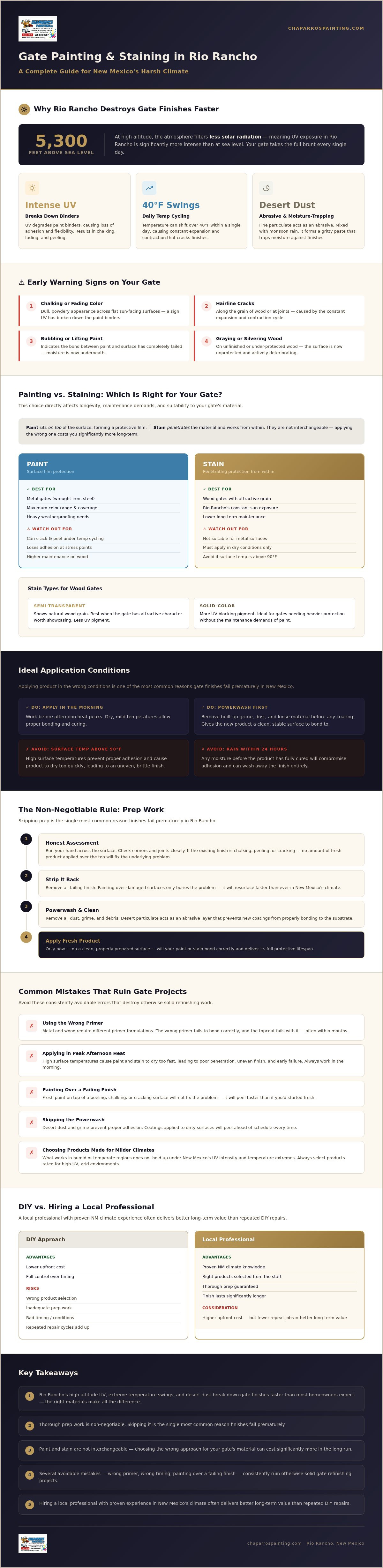
Rio Rancho sits at roughly 5,300 feet above sea level. That elevation matters more than most homeowners realize. At altitude, the atmosphere filters less solar radiation, which means UV exposure here is significantly more intense than at sea level. Combine that with temperature swings that can exceed 40 degrees Fahrenheit within a single day, and you have conditions that genuinely punish exterior finishes.
Gates take the full brunt of it. They face direct sun for hours at a time, expand and contract with every temperature shift, and collect fine desert dust that works its way into any surface imperfection. The result is a predictable cycle: finishes crack, moisture finds its way in, and the deterioration accelerates from there.
The Impact of UV Rays on Exterior Surfaces
UV degradation breaks down the binders in paint, causing them to lose adhesion and flexibility over time. On wood gates, this often shows up as chalking, where the surface takes on a dull, powdery appearance. On metal, UV exposure accelerates oxidation beneath the finish. Both scenarios lead to the same outcome: peeling, flaking, and a surface that no longer protects the substrate underneath.
Watch for these early warning signs on your gate:
- Chalking or fading color across flat, sun-facing surfaces
- Hairline cracks along the grain of wood or at joints
- Bubbling or lifting paint that indicates the bond has failed
- Graying or silvering on unfinished or under-protected wood
For certain wood types, a penetrating stain can outperform paint in this climate. Stains soak into the wood rather than sitting on top, so they don't create a surface film that can crack and peel. That makes them a practical choice for gates exposed to relentless New Mexico sun.
Desert Dust and Its Role in Paint Failure
Dust isn't just a cosmetic issue. Fine particulate matter settles into surface pores and acts as an abrasive, gradually wearing down the finish with every gust of wind. When dust mixes with the occasional monsoon rain, it forms a gritty paste that clings to surfaces and traps moisture against the finish.
Proper cleaning before any refinishing work is non-negotiable. Powerwashing removes built-up grime and loose material, giving new coatings a clean, stable surface to bond to. Skipping this step is one of the most common reasons gate finishes fail ahead of schedule.
Effective gate painting and staining in Rio Rancho starts with an honest assessment of what you're working with. Run your hand across the surface. Check corners and joints closely. If the existing finish is chalking, peeling, or cracking, no amount of fresh product applied over the top will fix the underlying problem. Strip it, clean it, and start fresh. That's the only approach that holds up here.
Painting vs. Staining: Which is Best for Your Gate?
The choice between paint and stain isn't just aesthetic. It directly affects how long your finish lasts, how much maintenance you'll deal with down the road, and whether the product you choose is actually suited to your gate's material. Getting this decision right from the start saves you real time and money.
Here's the core difference: paint sits on top of the surface and forms a protective film. Stain penetrates the material and works from within. Both approaches have legitimate advantages, but they're not interchangeable, and applying the wrong one to the wrong material is a mistake that shows up quickly in Rio Rancho's climate.
When to Choose Wood Staining
If your gate is wood and you want to preserve its natural grain and character, stain is almost always the better call. A quality penetrating stain soaks into the wood fibers rather than coating the surface, which means there's no film to crack, bubble, or peel under the stress of daily temperature cycling. For wood gates facing direct sun, that distinction matters enormously.
Stains also breathe. Wood expands and contracts with heat and humidity, and a penetrating finish moves with it. Paint, by contrast, can lose adhesion at those stress points over time. Semi-transparent stains are particularly effective for gates with attractive wood grain worth showcasing, while solid-color stains offer more UV-blocking pigment for gates that need heavier protection without the maintenance demands of paint.
Ideal conditions for staining are dry, mild temperatures, ideally in the morning before the afternoon heat peaks. Avoid applying stain when rain is forecast within 24 hours or when surface temperatures are above 90°F.
The Case for Painting Iron and Metal Gates
Metal gates need paint, not stain. Stain has nothing to penetrate on a metal surface, so it simply won't bond or protect. For iron and steel gates, a high-quality rust-inhibiting primer followed by a durable exterior enamel or oil-based topcoat is the standard approach that holds up in this environment.
Look for products specifically formulated for metal exteriors with UV-resistant pigments. Alkyd-based paints and direct-to-metal (DTM) coatings are both solid options. They resist chipping, stand up to thermal expansion, and maintain their color under intense sun exposure.
Maintenance is straightforward but requires consistency:
- Inspect annually for chips, scratches, or areas where rust is beginning to form beneath the finish
- Touch up bare spots promptly before oxidation spreads underneath the surrounding paint
- Clean the surface with mild soap and water to prevent dust and grime buildup from degrading the finish
- Recoat every few years depending on sun exposure and the quality of the original application
When it comes to gate painting and staining in Rio Rancho, the material your gate is made from should drive the decision first, and your aesthetic preferences second. Choosing the right approach from the start is the kind of detail that separates a finish that lasts from one that needs redoing in two seasons. If you're unsure which direction makes sense for your specific gate, talking through the options with an experienced local painter can save you from a costly misstep.
Step-by-Step Guide to a Professional Finish
Knowing which product to use is only half the battle. How you apply it determines whether that finish holds up for years or starts failing before the next monsoon season. This is where most DIY projects go sideways, not from bad materials, but from skipped steps and poor technique.
Preparing the Gate for Painting or Staining
Preparation is the work that actually makes a finish last. Start by gathering what you'll need before touching the gate:
- Pressure washer or stiff-bristle brush for deep cleaning
- Wire brush and paint scraper for removing loose or peeling finish
- 80 to 120-grit sandpaper for smoothing wood surfaces
- Rust-inhibiting primer for metal gates or bare wood spots
- Painter's tape and drop cloths to protect surrounding surfaces
- TSP cleaner or mild degreaser for cutting through grime and oxidation
Once you have your supplies, clean the gate thoroughly. Pressure wash wood gates to remove dust, mildew, and old residue. For metal, use a degreaser to strip oil and surface rust before anything else. Let the surface dry completely, at least 24 hours in Rio Rancho's dry air, before moving on.
Next, scrape and sand. Remove every flake of loose paint or stain. Leaving even a small section of compromised finish underneath new product is a guaranteed failure point. Sand wood gates with the grain to open the surface and improve adhesion. On metal, sand down any rust spots to bare metal before priming.
Primer isn't optional on bare wood or exposed metal. Apply a thin, even coat and let it cure fully according to the manufacturer's instructions. Rushing this step is one of the most consistent reasons gate painting and staining in Rio Rancho fails ahead of schedule.
Application Techniques for a Flawless Finish
Timing matters here. Apply paint or stain in the morning, after dew has evaporated but before afternoon temperatures climb. Surface temps above 90°F cause product to dry too fast, which leads to lap marks and poor penetration on wood.
For wood gates, a natural bristle brush gives you the most control and works product into the grain effectively. Rollers work on flat panels but miss edges and crevices. For metal gates with intricate ironwork, a brush is the only practical option for full coverage without runs.
Apply thin coats. Two thin coats outperform one heavy coat every time. A thick application traps solvents underneath and creates a surface that looks finished but hasn't bonded properly. Let each coat dry fully before adding the next.
Watch for drips immediately and brush them out before they set. Once paint or stain skins over, working it causes streaks that are difficult to correct without sanding back down.
If any of these steps feel uncertain, or if your gate has significant rust, deep wood damage, or a complicated finish history, that's a reasonable point to bring in a professional. A painter with real experience in this climate knows how to read the surface, adjust for conditions, and deliver results that hold. For a project this exposed to New Mexico's elements, getting it right the first time is always the more practical choice.
Common Mistakes That Ruin Gate Painting Projects
Even with the right products in hand, gate painting and staining in Rio Rancho goes wrong more often than it should. The culprit is rarely the paint itself. It's the decisions made before the first coat ever touches the surface, and the habits that get skipped once the job looks finished. Understanding where these projects break down helps you avoid repeating the same costly cycle.
Preparation Overlooked: The Cost of Cutting Corners
Inadequate cleaning is the most predictable path to early peeling. Dust, oxidation, and old residue act as a barrier between the new finish and the substrate. No matter how good the product is, it can't bond through contamination. The finish looks fine initially, then starts lifting at the edges within months.
Surface assessment matters just as much. Running a quick visual check isn't enough. Press firmly on areas that look intact. If the existing finish flexes or sounds hollow, it's already lost adhesion underneath. Painting over compromised sections doesn't stabilize them; it just delays the inevitable and makes the next repair harder.
Skipping primer is where many otherwise careful projects fall apart. Bare wood absorbs product unevenly without it, leading to blotchy color and weak adhesion at exposed spots. On metal, an unprimed surface starts oxidizing beneath the topcoat almost immediately. Primer isn't an add-on; it's the foundation the entire finish depends on.
Material Mistakes: Selecting the Right Products
One of the most common misconceptions is that any exterior-rated product will perform equally well in New Mexico's climate. It won't. Products formulated for humid coastal environments handle UV exposure and thermal stress very differently than those built for high-desert conditions. Reading "exterior use" on a label tells you very little about whether it's suited for Rio Rancho's specific demands.
Interior products on outdoor gates are another mistake that shows up regularly. They're not formulated to resist UV degradation, moisture infiltration, or temperature cycling. They fail fast, and they fail visibly.
A few material mistakes worth avoiding specifically:
- Using a water-based stain on a metal gate where it has nothing to penetrate and won't bond
- Applying a low-sheen interior paint to a surface that gets direct afternoon sun
- Choosing the cheapest primer available rather than one rated for the substrate you're working with
- Ignoring the manufacturer's recoat window and applying a second coat before the first has cured
Weather is the other factor that catches people off guard. Applying product when surface temperatures are too high causes it to skin over before it penetrates or bonds properly. Applying before rain rolls in, even a brief monsoon shower, can wash out a finish before it sets.
If you're unsure which products are right for your gate's material and condition, get a professional assessment from Chaparro's Painting before spending money on materials that won't hold up.
Why Professional Gate Refinishing Saves Money Long-Term
Hiring a professional costs more upfront than a weekend DIY project. That's true. But the comparison doesn't end there. When you factor in materials purchased twice, time spent redoing failed work, and the accelerated deterioration that follows a poorly executed finish, the math shifts quickly. In Rio Rancho's climate, a substandard job doesn't just look bad; it actively shortens the life of your gate.
Understanding the Long-Term Investment
A professionally refinished gate, done with the right prep, the right primer, and products suited to high-desert conditions, routinely outlasts DIY work by several years. That extended lifespan translates directly into fewer refinishing cycles and lower cumulative costs over time. Quality materials applied correctly also protect the gate's structural integrity, which matters when you're dealing with iron that can rust through or wood that can rot from the inside if moisture gets past a compromised finish.
There's also the property value angle. Your gate is one of the first things visitors and potential buyers see. A clean, well-maintained finish signals that the rest of the property is cared for. Letting it deteriorate does the opposite, and the impression is harder to reverse than most homeowners expect.
Professionals bring something else that's harder to quantify: the ability to identify problems before they become expensive. Catching early rust beneath a finish, spotting wood that's beginning to soften at the joints, or recognizing that a previous coating is incompatible with what's going on top, these aren't things most homeowners notice until it's already a bigger repair.
Customer Testimonials: Real Experiences from Rio Rancho
Homeowners who've worked with Chaparro's Painting on gate painting and staining in Rio Rancho consistently point to the same thing: the difference between what they tried to manage themselves and what a professional delivered wasn't just cosmetic. It held up. One customer noted that after two failed attempts at refinishing a wrought iron gate on their own, Chaparro's handled the prep and application properly the first time, and the finish was still solid years later.
Another local homeowner described hiring Chaparro's after a neighbor's recommendation. They'd been skeptical about the cost but said the result changed how they thought about the investment. The gate looked better than it had in years, and they hadn't touched it since.
That kind of outcome isn't accidental. It comes from over 20 years of experience working specifically in this climate, knowing which products perform and which ones fail, and doing the prep work that most shortcuts skip entirely.
If your gate needs refinishing and you want it done right the first time, reach out to Chaparro's Painting to discuss what your gate needs and what a professional finish can do for it long-term.
Your Gate Deserves a Finish That Actually Holds Up
Rio Rancho's climate doesn't forgive shortcuts. Between the high-altitude UV exposure, daily temperature swings, and fine desert dust, gate finishes here face conditions that most products simply aren't built for. Getting it right means choosing the correct approach for your gate's material, doing the prep work properly, and using products suited to this specific environment.
The difference between a finish that lasts and one that fails within a season almost always comes down to those fundamentals. Skip them, and you're back to square one faster than you'd expect.
When you're ready to stop repeating that cycle, Chaparro's Painting brings over 20 years of residential painting experience and a deep familiarity with what works in New Mexico's climate. Gate painting and staining in Rio Rancho is what we do, and we do it right the first time.
Get a free estimate for your gate painting project today! Your gate takes a beating every day. Give it a finish that's built to take it.
Frequently Asked Questions About Gate Painting and Staining in Rio Rancho
How often should I paint or stain my gate in Rio Rancho?
Most gates in Rio Rancho need refinishing every two to four years, though that range shifts depending on material, sun exposure, and the quality of the original application. Metal gates in full afternoon sun may need attention sooner. Wood gates finished with a penetrating stain often hold up longer than painted surfaces because there's no film to crack and peel. Annual inspections help you catch early signs of wear before a touch-up becomes a full refinishing job.
What are the best products for gate painting in New Mexico?
For metal gates, rust-inhibiting primer paired with a UV-resistant exterior enamel or direct-to-metal coating performs well in New Mexico's high-desert conditions. For wood gates, semi-transparent or solid-color penetrating stains rated for high UV exposure outperform standard exterior paints in most situations. The key is choosing products formulated for intense sun and thermal cycling, not just any label that says "exterior use." A local professional familiar with Rio Rancho's climate can point you toward what actually holds up here.
Can I paint over existing paint on my gate?
You can, but only if the existing finish is clean, fully adhered, and compatible with the new product. If the current paint is chalking, peeling, or lifting in any area, painting over it won't fix those spots; it'll just bury the problem until it resurfaces worse. Scrape, sand, and prime any compromised areas before applying a new coat. Skipping that step is one of the most consistent reasons gate painting and staining in Rio Rancho fails ahead of schedule.
How do I know if my gate needs to be painted or stained?
Start with the material. Metal gates need paint; stain has nothing to bond to on a non-porous surface. Wood gates can go either way, but if the grain is worth preserving, a penetrating stain is usually the better long-term choice. Beyond material, look at the condition of the current finish. Widespread peeling, deep fading, or chalking means it's time to refinish regardless of what was used before. If you're unsure, a hands-on assessment from an experienced painter will give you a clear answer fast.
What is the average cost of gate painting and staining in Rio Rancho?
Costs vary based on gate size, material, current condition, and how much prep work is required. A simple wood gate in decent condition costs less to refinish than a large wrought iron gate with rust spots that need treatment before any coating goes on. Rather than relying on general estimates that may not reflect your specific situation, get a direct quote from a local professional who can assess the gate in person. That's the only number that actually applies to your project.
Do I need to hire a professional for gate refinishing?
Not always, but the complexity of the job should drive that decision. A small wood gate in good condition with a straightforward finish history is a manageable DIY project if you're willing to do the prep work properly. A metal gate with rust, a gate with multiple layers of incompatible coatings, or any gate that's deteriorated significantly is a different situation. Getting it wrong means stripping and starting over, which costs more than hiring a professional from the start. When the stakes are higher, experienced hands deliver better long-term value.


