

Could a laundry-room floor that looks sound still be a poor candidate for epoxy? If you’re researching “epoxy flooring for laundry rooms Albuquerque,” the answer depends less on appearance than on the condition and moisture level of the slab beneath it.
A floor that handles detergent spills, appliance movement, and everyday moisture starts with the right surface and installation plan. Before choosing a finish, consider what’s underfoot, how the room is used, and whether the floor needs repairs or other preparation.
This guide covers floor conditions that may make epoxy a practical option, why moisture checks and thorough preparation matter, and what to ask about the coating system, installation, and return-to-use instructions. It also offers a framework for comparing local residential contractors. Chaparro's Painting, LLC serves homeowners in Albuquerque and nearby communities with residential epoxy flooring and surface preparation. Owner Jaime Chaparro brings more than 20 years of industry experience. Use the questions below to set clear expectations before approving a project.
Key Takeaways
- Epoxy can suit some laundry rooms, but the existing floor and proposed coating system should guide the decision.
- Compare epoxy, tile, and resilient flooring by seams, repair needs, upkeep, and installation disruption.
- For epoxy flooring for laundry rooms Albuquerque homeowners should ask how the contractor will assess and prepare the floor before coating.
- Request a written project scope, details about the proposed coating system, and product-specific care and curing instructions.
Is epoxy flooring for an Albuquerque laundry room a practical choice?
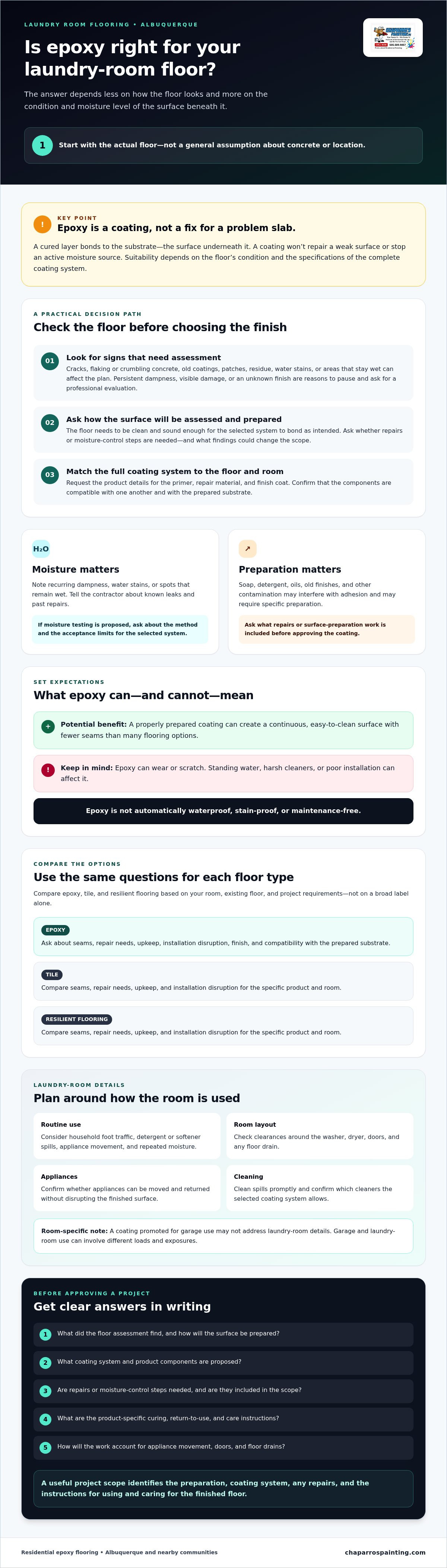
Epoxy may work well in some Albuquerque laundry rooms, but the concrete’s condition and the selected coating system matter. A properly prepared coating can create a continuous, easy-to-clean surface with fewer seams than many flooring options. It can still wear or scratch, and standing water, harsh cleaners, or poor installation can affect it. Epoxy is not automatically waterproof, stain-proof, or maintenance-free.
An epoxy floor coating is a cured layer applied over a substrate, not the concrete slab itself. Its performance depends on how well it bonds to that surface. For a plain-language overview of what epoxy is, see Wikipedia’s explanation of epoxy resins and curing.
Consider your routine. Clean detergent or softener spills promptly, and don’t ignore repeated dampness or seal over it without an assessment. Think about foot traffic, appliance placement, and whether you’ll need to move appliances to clean underneath. Before choosing a coating, confirm which cleaners the selected system allows.
Albuquerque homes can have very different floor conditions. A laundry room may have bare concrete, an older coating, patches, cracks, or signs of moisture. Age, previous repairs, and how the room is used can affect what a contractor finds. A local evaluation is more useful than assuming the slab is suitable based on location alone. Choosing epoxy flooring for laundry rooms Albuquerque homeowners can assess starts with the actual floor, not a general claim about local concrete.
What makes a laundry room different from a garage?
Laundry rooms typically involve household foot traffic, splashes, and repeated appliance use. Garages may face vehicle loads and different exposure. A coating promoted for garage use may not address laundry-room details. Check clearances around the washer, dryer, doors, and any floor drain. Confirm whether appliances can be moved and returned without disrupting the finished surface.
When should a homeowner consider another flooring option?
Visible damage, persistent dampness, or an unknown existing finish are reasons to pause and request a professional assessment. These conditions don’t automatically rule out epoxy, but the substrate and proposed system need to be compatible. Ask how the floor will be evaluated and which findings could change the plan. If the slab or existing finish needs work, clarify that scope before approving a coating.
How moisture, concrete condition, and coating choice affect Albuquerque laundry-room epoxy
The substrate is the surface that receives a coating. For a concrete laundry-room floor, cleanliness, soundness, and moisture condition all affect whether the coating can bond as intended. Epoxy won’t fix a weak surface or stop an active moisture source. The floor needs an honest assessment before the coating system is selected.
A coating’s suitability depends on the substrate’s condition and the specifications of the complete coating system. That system may include a primer, repair material, and finish coat. Its components need to be compatible with one another and with the floor. Ask the contractor to identify the proposed system rather than relying on a broad label such as “epoxy.”
What should be checked before coating a laundry-room floor?
Look for cracks, flaking or crumbling concrete, old coatings, and residue that could interfere with adhesion. Soap, detergent, oils, and other contamination may require specific cleaning and preparation. Note recurring dampness, water stains, or areas that stay wet, and tell the contractor about any known leaks or past repairs.
Ask how the contractor will assess the floor and decide whether repairs are needed. If moisture testing is proposed, confirm the method and the acceptance limits for the selected system. Requirements vary by product and site conditions. Before work begins, ask the contractor to explain the findings and any required repairs or moisture-control steps.
How do epoxy and other resinous floor coatings differ?
Epoxy and polyurethane are different resin chemistries used in floor-coating systems. Their properties and intended roles vary by formulation. One may be specified as a coating layer, while another may be used as a finish coat within a system. Neither category is automatically best for every home. Compare the actual product information for intended use, finish, maintenance, and compatibility with the prepared substrate.
For a laundry room, ask how the proposed finish is expected to handle routine cleaning and household use, and which care instructions apply. Request the product details in writing, including any limits related to moisture or the existing floor. This makes it easier to compare systems on more than appearance.
Location alone doesn’t determine a slab’s condition. Existing finishes, previous repairs, room history, and current moisture signs all matter. A site-specific review can clarify whether the floor is a candidate and what preparation it needs. Chaparro's Painting, LLC provides residential epoxy flooring and surface preparation. Its residential epoxy flooring information is one starting point for a project discussion.
Epoxy vs. other laundry-room floors: what should Albuquerque homeowners compare?
Epoxy isn’t the only option for a laundry room. Tile and resilient sheet or plank flooring may also work, depending on the existing floor, water exposure, comfort preferences, and tolerance for installation work. Rather than judging a flooring type in general, compare the specific product, installation plan, and room conditions.
| Flooring | Maintenance and seams | Repair considerations | Installation and substrate |
|---|---|---|---|
| Epoxy coating | Creates a continuous surface with few joints; follow the system’s cleaning instructions. | Damage may require a compatible repair or recoating, and a local repair may look different. | Requires suitable, properly prepared concrete. Preparation and curing can limit room use during the project. |
| Tile | Tile faces are generally straightforward to clean, while grout lines and edges need attention. | An individual tile may be replaceable, though matching it and repairing grout can be challenging. | Needs a stable, appropriately prepared base. Cutting, setting, and curing materials can disrupt room use. |
| Resilient sheet or plank | Sheet flooring can reduce seams; planks have more joints. Follow the product’s cleaning guidance. | A damaged area may need patching or replacement, depending on product and installation. | Subfloor condition and moisture requirements vary by product. Preparation and fitting affect disruption. |
This is a general comparison, not a performance guarantee. Product construction, installation quality, and room conditions all matter. Before comparing claims, check manufacturer documentation for care, water exposure, slip resistance, installation requirements, and repair guidance.
Which floor characteristics matter most in a laundry room?
Start with cleanability, comfort underfoot, likely water exposure, and how much routine maintenance you’re willing to do. Ask for product-specific information about the finish and slip resistance, especially if the floor may get wet. Joints, edges, and transitions matter too: they can collect soil, complicate cleaning, or affect how spills move into adjacent rooms. Note any floor drain and ask how the proposed layout will accommodate it.
How should homeowners assess appearance and upkeep?
Ask which finishes are available in the proposed coating system, then compare samples or product information where possible. Check the manufacturer’s instructions for routine care and repairs. Don’t assume every coating has the same appearance or stain resistance. Tile and resilient flooring may have details that are familiar and easier to assess, but resin coatings deserve the same careful, written comparison.
A residential epoxy garage-floor article can help explain coating considerations, but garage guidance may not transfer directly. Laundry rooms have different appliance layouts, water exposure, and traffic. For epoxy flooring for laundry rooms Albuquerque homeowners should compare the room’s actual requirements with the proposed system, not rely on garage-specific claims alone.
What happens during laundry-room epoxy preparation and installation in Albuquerque?
A clear installation plan explains more than how the coating will be applied. It should cover how the floor will be assessed, what preparation is required, and when the room can return to use. Surface preparation is central to coating performance because the system needs a clean, sound, properly prepared surface to bond as intended.
- Site review: The contractor reviews the concrete, existing finishes, room layout, and signs of damage or moisture. Discuss appliance locations, access, ventilation, and household routines before scheduling the work.
- Floor preparation: The crew identifies contaminants or old coatings that may interfere with adhesion and explains how they’ll be handled. Preparation methods should suit both the substrate and the proposed coating system.
- Repairs: Cracks or other surface defects may need attention before coating. Ask which repairs are included and how the contractor will determine whether they suit the selected system.
- Coating application: The installer applies the specified system according to its product instructions. Confirm the planned layers and any limits relevant to your floor.
- Curing: The coating needs time before foot traffic, appliance replacement, and normal laundry use. Get the product-specific timeline in writing.
Preparation and curing requirements vary by product, substrate, and site conditions. Don’t rely on a generic timeline. For epoxy flooring for laundry rooms Albuquerque homeowners should request a project plan based on the actual room and selected system.
What should a contractor explain about floor preparation?
Ask how existing coatings and contaminants will be assessed, and whether removal is required. Request details about crack repair, surface profiling, and moisture evaluation, including how the results could affect the proposed system. Clarify who moves the washer and dryer, what happens to them during the work, and whether plumbing or electrical disconnection is outside the project scope. Agree on those responsibilities before installation day.
How should homeowners plan around curing and room access?
Ask for written guidance on when people can walk on the floor, when appliances can be returned, and when the room can handle normal use. These milestones may differ. Arrange another way to do laundry until the contractor confirms the floor is ready, and discuss access to and ventilation of the work area during installation. Follow the selected system’s instructions instead of assuming one cure time fits every job.
A written scope makes preparation, responsibilities, and timing easier to review. Chaparro's Painting, LLC offers residential epoxy flooring and surface preparation. Discuss your laundry-room epoxy project and clarify the floor assessment and preparation plan before approving the work.
How to choose an Albuquerque epoxy flooring contractor for your laundry room
Choose a contractor who can explain the floor assessment and preparation plan in plain language, not just describe the finished look. Residential epoxy experience matters because a laundry room has its own layout, appliance needs, and water exposure. For epoxy flooring for laundry rooms Albuquerque homeowners should compare written scopes and proposed systems rather than relying on broad claims about durability.
A clear estimate should identify the included work, such as surface assessment, preparation, repairs, coating application, and cleanup. It should also explain exclusions, appliance-moving responsibilities, access needs, and conditions that could change the work. Don’t approve a plan until you understand what the contractor will do and what the household must handle.
What questions should you ask before approving an epoxy floor?
Use these questions to compare project details:
- Which coating system do you propose, and can I review its manufacturer documentation?
- How will you assess the concrete, check for moisture, and determine whether repairs are needed?
- How will existing coatings or contamination be handled, and what surface preparation is included?
- Who moves the washer and dryer? Are plumbing or electrical disconnection and reconnection excluded?
- What room-access limits should I expect, and when can people walk on the floor, appliances return, and normal use resume?
- What care instructions and repair guidance does the manufacturer provide for this specific system?
Ask for the answers in writing. Product details, findings about the floor, preparation steps, schedule expectations, and exclusions help establish a shared understanding before work begins. If an answer is unclear, ask for a practical explanation or the relevant product information.
What can Albuquerque homeowners expect from Chaparro’s Painting?
Chaparro’s Painting, LLC serves residential customers in Albuquerque and nearby communities, including Rio Rancho, Bernalillo, and Santa Fe. The company offers residential epoxy flooring and surface preparation. Owner Jaime Chaparro brings more than 20 years of industry experience. The proposed system and its suitability still need to be confirmed for each floor and project.
An initial conversation can cover the room layout, existing floor, visible damage or moisture concerns, and expectations for preparation and access. That discussion can help identify what needs an on-site assessment and what belongs in the written scope. Discuss your laundry-room epoxy project with Chaparro’s Painting and ask what information is needed to assess the floor and outline next steps.
Make Your Laundry-Room Flooring Decision With Confidence
Epoxy can be a sensible laundry-room option when the concrete is suitable and the coating system fits the space. Start with the slab: assess its condition and moisture before choosing a finish. Then compare epoxy with tile or resilient flooring based on cleaning, seams, repairs, and how you use the room. A written scope should explain preparation, appliance handling, product-specific care, and when the floor can return to service.
For homeowners considering epoxy flooring for laundry rooms Albuquerque, a clear conversation about the existing floor is a practical next step. Chaparro’s Painting, LLC offers residential epoxy flooring and surface preparation in Albuquerque and nearby communities, including Rio Rancho, Bernalillo, and Santa Fe. Owner Jaime Chaparro brings over 20 years of industry experience. Discuss the room, floor condition, and project expectations before deciding whether epoxy fits.
Discuss your Albuquerque laundry-room flooring project with Chaparro’s Painting. With the right questions and a site-specific plan, you can make a more informed flooring decision.
Frequently Asked Questions
Is epoxy flooring a good choice for a laundry room?
Epoxy can be a good option if the floor and coating system are compatible and the surface is properly prepared. A continuous coating can simplify routine cleaning, but spills should still be cleaned promptly, and epoxy isn’t automatically waterproof or maintenance-free. Consider water exposure, appliance placement, and how you use the room. For epoxy flooring for laundry rooms Albuquerque homeowners should arrange a floor assessment before choosing a system.
Can epoxy flooring be installed over tile in a laundry room?
Sometimes, but don’t assume a coating will bond successfully to existing tile. The contractor needs to assess the tile’s condition, grout, surface finish, and any loose or damaged areas. Compatibility depends on the substrate and the selected coating system. Ask whether the manufacturer approves that application and what preparation it requires. The assessment may show that tile removal or a different flooring plan is needed.
How long does laundry-room epoxy flooring take to install and cure?
There isn’t one timeline that applies to every laundry-room floor. Assessment, preparation, repairs, the number of coating layers, and site conditions can all affect the schedule. Curing is product-specific too. Ask for written guidance on when the floor can handle foot traffic, when appliances can be returned, and when normal laundry use can resume. Follow the selected system’s instructions rather than relying on a generic estimate.
Will epoxy flooring make a laundry room waterproof?
No. An epoxy coating shouldn’t be treated as a guaranteed waterproof barrier or a fix for leaks and persistent moisture. Cracks, edges, transitions, drains, and the condition of the concrete can affect how water behaves in the room. Ask the contractor to assess moisture and explain what the proposed system is designed to do. Address any known leak or recurring dampness before deciding whether to coat the floor.
Is epoxy flooring slippery when wet?
It can be, depending on the coating’s finish, the presence of water or detergent, and the footwear used. Don’t assume a finish is slip-resistant based on a general description. Ask for product-specific information about the proposed surface and its slip characteristics, then consider how water may reach the floor near the washer or sink. Follow the manufacturer’s care instructions, since cleaning residue can also affect footing.
Can washers and dryers be placed back on epoxy flooring right away?
No, not unless the contractor and product instructions confirm the floor is ready for appliances. The coating may need different curing periods for foot traffic, appliance placement, and normal use. Moving a washer or dryer too soon, or dragging it across the floor, could damage the finish. Get return-to-use guidance in writing and arrange another laundry option until the contractor confirms the floor can handle the appliances.
How do I choose an epoxy flooring contractor in Albuquerque?
Look for residential experience and a written scope that identifies the floor assessment, preparation, proposed coating system, repairs, appliance responsibilities, and product-specific care instructions. Ask how moisture and existing damage will be evaluated, and request manufacturer documentation. Chaparro’s Painting, LLC offers residential epoxy flooring and surface preparation. Jaime Chaparro has over 20 years of industry experience. Ask about project scope and availability in Albuquerque, Rio Rancho, Bernalillo, or Santa Fe.


