
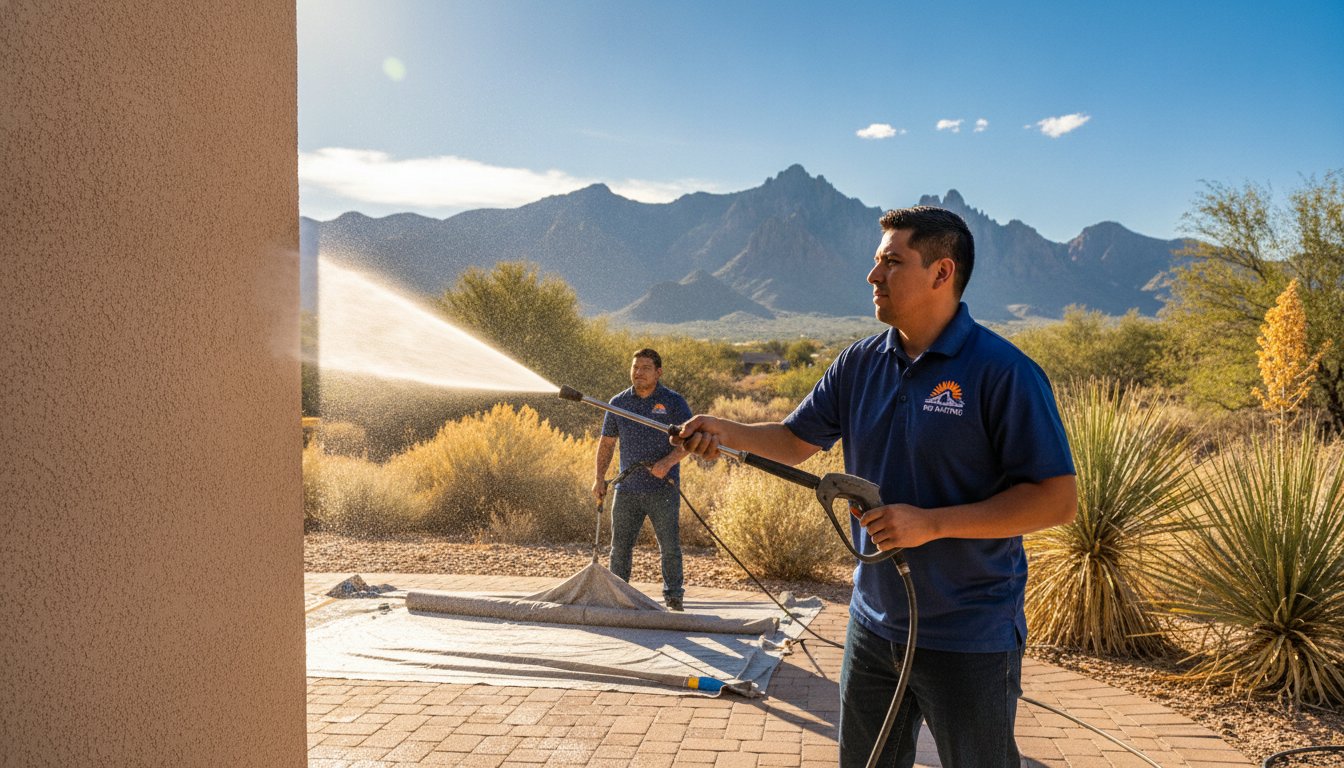
That high-pressure nozzle might be the biggest threat to your home's new look. Most people assume that "blasting" away dirt is the best way to handle pressure washing before painting, but excessive force often drives water deep into your stucco. This trapped moisture is the primary reason paint starts peeling just two seasons later. You want a clean surface, not a water-damaged structure that requires costly repairs.
It's natural to feel frustrated by conflicting advice on equipment settings or to worry about how the New Mexico sun affects your prep work. You're looking for a finish that lasts decades, not a quick fix that fails. In this article, you'll discover why the secret to a long-lasting job is low pressure and high volume. We'll walk through the professional decontamination process, explain how to avoid moisture traps in stucco, and give you the checklist needed for a truly durable exterior finish.
Key Takeaways
- High pressure can damage your home and trap moisture in the walls. Learn why soft washing is the professional standard for a safe, thorough clean.
- Effective pressure washing before painting removes microscopic chalking and dust that a standard garden hose can't reach.
- New Mexico homes face unique challenges like high UV and wind. Discover how to prep desert stucco to prevent cracks and premature peeling.
- Protect your investment by following a professional checklist for landscaping, electrical outlets, and lead paint safety.
- A meticulous "prep-first" philosophy ensures your exterior finish stands up to the local climate for decades.
The Myth of the "Quick Rinse": Why Surface Prep is More Than Just Water
Pressure washing before painting isn't about making the house look pretty for a few hours. It's a decontamination process. Professionals view this step as the foundation of the entire project. If this foundation is weak, the topcoat will fail regardless of how expensive the paint is. A standard garden hose might move loose dirt, but it lacks the pressure to reach into the pores of your stucco or strip away microscopic layers of oxidation. Many homeowners look at a wall that appears clean and assume it's ready for a brush. This is a mistake that leads to peeling paint within twenty-four months.
Chalking, Oxidation, and the Invisible Enemies of Paint
Over time, the intense New Mexico sun breaks down the resins in your old paint. This process is called chalking. It leaves a fine, powdery residue on the surface that acts like a layer of flour on a baking sheet. If you try to paint over it, the new layer sticks to the powder instead of the wall. In Rio Rancho and Albuquerque, we also deal with caliche dust and fine desert silt. These particles are incredibly small and wedge themselves deep into the texture of the stucco. Surface oils and grease create a chemical barrier that causes immediate adhesion failure by preventing the new coating from wetting the substrate.
The Difference Between Cleaning and Decontaminating
Professional prep involves more than just high-pressure water. In fact, using too much pressure can actually damage the surface. We focus on using specialized detergents and surfactants to break the chemical bond between the dirt and your home. Understanding Paint composition and properties helps explain why this bond is so fragile. Most modern paints rely on a chemical grip that is easily disrupted by a single layer of dust or oil.
Decontaminating also means addressing biological growth. Even in our dry climate, shaded areas or spots near leaky gutters can host mildew. We use mildewcides during the wash to kill these spores. If you don't kill the mildew, it will continue to grow under your new paint, eventually bubbling the film from the inside out. This thorough approach ensures a uniform surface tension. When the primer hits the wall, it can soak in evenly, creating the durable bond required for a finish that lasts decades. Proper pressure washing before painting is the only way to guarantee the surface is truly ready for a new coat.
The Danger of High PSI: Why More Pressure Isn’t Better
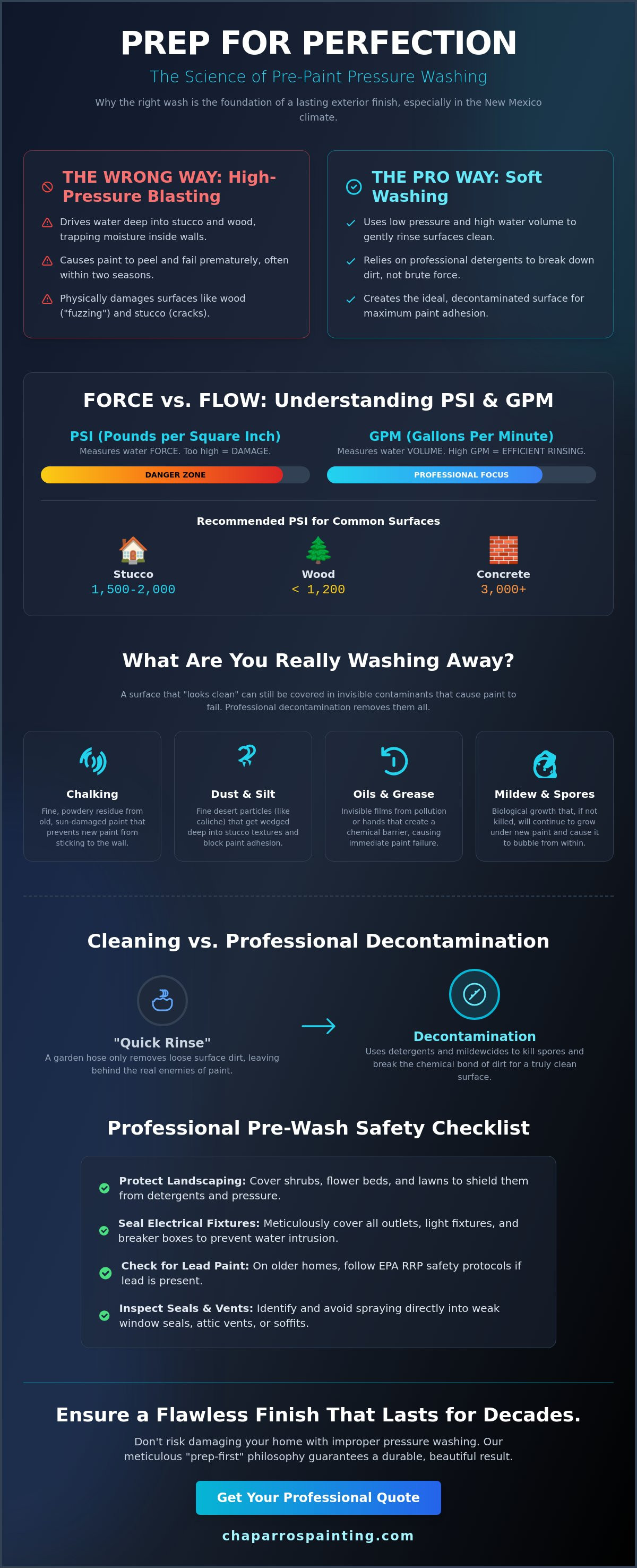
Many homeowners rent the most powerful machine available, thinking it will save time. They see a 3,500 PSI rating and equate it with a better clean. In reality, that kind of force is rarely necessary for pressure washing before painting. Using excessive pressure is like using a sledgehammer when a rubber mallet is required. You want to decontaminate the surface, not blast it into submission. High pressure often causes more problems than it solves.
Understanding PSI vs. GPM (Gallons Per Minute)
PSI measures the force of the water hitting the wall. GPM measures the volume of water flowing through the machine. Professional setups often prioritize high GPM over high PSI. High volume allows us to rinse away detergents and loosened contaminants quickly without needing to get the nozzle dangerously close to your home. It's the volume of water that carries away the dirt, not the speed at which it hits the surface.
- Stucco: 1,500 to 2,000 PSI is usually the safe limit.
- Wood: Keep settings under 1,200 PSI to prevent fiber damage.
- Concrete: This is the only place where 3,000+ PSI is appropriate.
Machines found at big-box rental stores are often overkill for simple paint preparation. They're designed for generic tasks, but a house exterior requires a more surgical approach. If you aren't comfortable managing these settings, our team at Chaparro's Painting, LLC can handle the technical details for you.
Surface Damage: When Pressure Washing Goes Wrong
High pressure can physically alter your home's materials in ways that are hard to fix. On wood siding or trim, it often "fuzzes" the grain. This happens when the water pressure rips the soft wood fibers, leaving a rough, hairy texture. You'll have to spend hours sanding those surfaces back down before you can even think about painting. On stucco, a high-pressure stream can strip away the finish coat or widen existing hairline cracks, making your prep work much more difficult.
The most dangerous risk is "injection" damage. Excessive force can drive water behind window seals, through attic vents, or under the vapor barrier. Once water is trapped in the wall cavity, it doesn't dry easily. This leads to hidden mold growth and wood rot. It also ruins the paint job from the inside out. As the trapped moisture tries to escape through the wall, it will cause your new paint film to bubble and peel. A seasoned professional uses "soft washing" techniques, relying on the right chemical balance rather than raw power to get the job done right. This ensures the surface is clean without compromising the integrity of the structure.
The New Mexico Factor: Dust, Stucco, and Desert Drying
Rio Rancho and Albuquerque homes face environmental pressures that most national painting guides ignore. Our intense UV exposure and constant wind create a surface that is often baked and dusty simultaneously. Performing pressure washing before painting in this climate isn't just about removing dirt. It's about managing the unique behavior of stucco under high-altitude conditions. If you don't account for these local factors, your new finish will likely fail prematurely. The goal is to find the perfect window between a clean surface and the next dust storm.
Prepping Stucco for Success in Rio Rancho
Efflorescence is a common sight on New Mexico stucco. These white, crusty salt deposits appear when moisture moves through the substrate and evaporates on the surface, leaving minerals behind. You cannot simply paint over these salts. They must be chemically neutralized and rinsed away during the prep phase. We also pay close attention to hairline cracks. These small openings act as traps for fine desert silt and caliche dust. While washing, we aim to clear the debris from these cracks so that our high-quality sealants and primers can actually reach the substrate.
It is vital to perform all stucco repairs after the washing is complete. This sequence is a non-negotiable standard for professional prep. If you repair the cracks first, the subsequent pressure wash can blow out the fresh patches or prevent the repair material from curing properly. Washing first reveals the true extent of the damage, allowing for a more thorough repair process before the first drop of primer hits the wall.
The "Desert Dry" Rule: Timing Your Paint Job
One advantage of the New Mexico climate is our rapid evaporation rate. In humid East Coast states, a home might need a week to dry after a deep clean. In Bernalillo County, the 24-hour rule is usually sufficient for most surfaces due to our low humidity levels. However, you shouldn't guess when it comes to the integrity of your home. We recommend using a moisture meter to verify readiness, especially on north-facing walls or areas heavily shaded by landscaping that don't get direct sun.
- Target Moisture: Always wait until the moisture content is below 15% before applying primer.
- North-Facing Walls: These areas can take twice as long to dry as south-facing walls.
- Wind Awareness: If a dust storm occurs shortly after washing, the surface may need a light "tack-off" rinse to remove new debris.
Timing is everything in the high desert. If you wait too long after pressure washing before painting, the relentless wind will simply redeposit a layer of dust on your clean walls. A disciplined professional schedules the wash and the paint application close together to ensure the bond is made while the surface is at its peak cleanliness. This methodical approach is the only way to guarantee a finish that stands up to the New Mexico sun for years to come.
A Homeowner’s Prep Checklist: How to Do It Right
Before you pull the trigger on a pressure washer, you need a disciplined plan. Pressure washing before painting is a multi-step process that starts long before you turn on the water. If your home was built before 1978, the first priority is a lead paint inspection. As of January 12, 2026, the EPA has implemented stricter standards for lead-based paint dust. High-pressure water can disturb lead-based coatings and contaminate your soil. If you suspect lead, you must follow specific RRP (Renovation, Repair and Painting) protocols to keep your family safe.
Next, secure the perimeter. Rio Rancho homes often feature delicate desert landscaping that can't handle harsh runoff. Thoroughly saturate your plants with fresh water before and after the cleaning process. This dilutes any detergents that might reach the root systems. Cover your outdoor electrical outlets and AC units with heavy-duty plastic. Use painters tape to seal utility meters and lighting fixtures. Professional prep work means leaving the property in the same condition we found it.
Choosing the right solution is about chemistry, not just brute force. While many people reach for bleach, a professional-grade surfactant is more effective at breaking down oils and desert silt. Bleach kills organic growth like mildew, but it doesn't lift the dirt that prevents paint from sticking. Once you start washing, use a top-down approach. If you start at the bottom, dirty water will run over your clean sections and create permanent streaks that are difficult to cover.
Landscaping and Utility Protection
Rio Rancho utility meters and outdoor lighting fixtures are often overlooked during a DIY job. Secure these with plastic sheeting and tape. Also, be mindful of where your wash water goes. In New Mexico, local regulations often govern the disposal of wash water, especially if you're using heavy detergents. We prioritize environmentally responsible practices to protect our local water table. Many desert plants are heat-sensitive; avoid washing during the hottest part of the day to prevent the sun from "cooking" any soap residue on the leaves.
The Professional Technique: "Down and Away"
The "Down and Away" technique is the industry standard. Never spray upward into eaves or under the laps of your siding. This forces water into the wall cavity, which leads to rot. Maintaining the correct nozzle distance is a skill that takes years to master. If you get too close, you'll etch the surface. If you're too far, the water just bounces off. A consistent distance prevents "tiger striping," which are uneven lines caused by varying pressure.
Once the house is dry, perform a swipe test. Rub your hand across the surface; if any chalky residue remains, the decontamination isn't finished. A clean surface shouldn't leave any dust on your fingertips. If you'd rather leave these technical steps to the experts, you can schedule professional prep work with our experienced team. We'll ensure your home is perfectly primed for its new finish.
Professional Prep with Chaparro's Painting, LLC: 20 Years of Expertise
Experience is the best teacher in the high desert. We've spent over two decades refining our process specifically for Rio Rancho and Albuquerque homes. We know that pressure washing before painting is the most critical phase of the entire project. Our "Prep-First" philosophy means we never cut corners on the foundation of your paint job. We don't just spray water; we decontaminate the substrate to ensure the longest possible life for your new coating. This disciplined approach is why local homeowners trust us to deliver a finish that stands up to our intense climate.
Our team understands the delicate balance required for residential exteriors. We aren't a high-volume commercial outfit that rushes through prep to get to the next building. We are residential specialists. This focus allows us to provide a level of thoroughness that generic contractors often miss. We integrate our powerwashing services directly with our stucco repair and wood staining workflows. This ensures that every surface is treated according to its specific needs, whether it's porous stucco or weathered wood trim. By choosing Chaparro's Painting, LLC, you're choosing a partner who understands the chemistry of the job.
Our Specialized Stucco and Gate Prep
Stucco and wood require different techniques and different levels of care. For gate staining prep, we use a low-pressure wash combined with specific cleaners to open the wood pores. This allows the stain to penetrate deeply into the grain, providing a barrier against the NM sun. When it comes to stucco painting, we identify every hairline crack and salt deposit after the initial clean. Our craftsmen match the new repair texture to your existing walls with precision. We take pride in these small details because they make the difference between a "painted house" and a professionally restored home.
Get a Professional Finish That Lasts
Investing in professional prep work provides a much higher ROI than attempting DIY shortcuts. A failed paint job often costs twice as much to fix as it does to perform the work correctly the first time. We prioritize transparent communication from the moment we arrive at your door. You'll receive a clear outline of our process, from the initial wash to the final inspection. We arrive on time, maintain a clean job site, and follow through on every promise. We treat your home with the same quiet pride and respect we would our own. Ready for a refresh? Schedule your free exterior estimate today!
Doing the job right means respecting the materials and the environment. We use professional-grade equipment that allows for fine-tuned pressure settings. This prevents the "injection" damage and surface etching discussed in previous sections. By choosing a seasoned local expert like Chaparro's Painting, LLC, you gain the peace of mind that comes from 20 years of proven results. We don't just want to paint your house today; we want to provide a finish that you'll be proud of for the next decade.
Protect Your Investment with Professional Prep
A lasting paint job starts with a disciplined approach to cleaning. You now understand that effective pressure washing before painting is a decontamination process rather than a test of raw power. By avoiding high-pressure mistakes and accounting for the unique dust and stucco challenges in the high desert, you ensure your home stays protected for years. Proper prep isn't just a recommendation; it's the foundation of quality craftsmanship. Doing the job right means looking past the surface and respecting the materials of your home.
Chaparro's Painting, LLC brings over 20 years of local NM experience to every project. We are residential craftsmanship experts who specialize in the meticulous stucco repair and painting required for our local environment. We treat every home with the care it deserves, ensuring a finish that doesn't just look good today but stands the test of time. Ready to start your home's transformation? Get Your Free Rio Rancho Painting Estimate today. We look forward to helping you achieve a durable, professional finish that you can be proud of for years to come.
Frequently Asked Questions
How long should I wait to paint after pressure washing?
You should typically wait at least 24 hours in the low-humidity New Mexico climate. While humid regions might require several days to dry, our rapid evaporation rates often allow for a quicker turnaround. Use a moisture meter to confirm the surface is below 15% moisture before applying primer. North-facing walls or heavily shaded areas may need an extra day to ensure no water remains trapped in the stucco pores.
Is it possible to damage my stucco by pressure washing it too hard?
Yes, excessive pressure can easily shred the finish coat of your stucco or widen existing hairline cracks. High-pressure streams can also force water behind the vapor barrier, leading to hidden mold and rot. We recommend keeping settings between 1,500 and 2,000 PSI for most stucco surfaces. Using a "soft wash" technique with the right detergents is much safer than relying on raw water force alone.
Do I need to use soap, or is water enough to clean my house for painting?
Water alone is rarely enough to properly decontaminate a surface for a long-lasting paint job. Specialized detergents are necessary to break down surface oils, caliche dust, and microscopic chalking that prevent paint from bonding. These solutions also include mildewcides to kill spores that might otherwise grow under your new paint film. Professional pressure washing before painting always involves a balanced chemical cleaning phase followed by a thorough rinse.
What is the best PSI for washing a house before painting?
The ideal PSI depends entirely on the material you are cleaning. For wood siding and trim, stay below 1,200 PSI to avoid "fuzzing" or ripping the wood fibers. Stucco is best handled at 1,500 to 2,000 PSI to remove dirt without etching the finish. Concrete is the only residential surface where 3,000+ PSI is appropriate. Professionals often prioritize GPM (Gallons Per Minute) over PSI to ensure a high-volume rinse without the risk of damage.
Can I skip pressure washing if my house looks clean?
You should never skip the washing phase, even if your walls appear clean to the naked eye. Invisible enemies like oxidation, surface oils, and fine desert silt can still ruin paint adhesion. If you skip this step, the new paint will stick to the dust or chalky residue instead of the wall itself. This results in peeling and bubbling within a few seasons, regardless of the paint quality you choose to use.
Will pressure washing remove all the old peeling paint?
Pressure washing will remove loose, flaking paint, but it is not a substitute for manual scraping and sanding. If you try to blast off every bit of old paint with water, you will likely damage the underlying wood or stucco. The wash is intended to clean the surface and identify weak spots. Once the house is dry, a professional will go back and hand-scrape the remaining edges to ensure a smooth, stable surface for the primer.
How do I protect my plants and AC unit during the wash?
Protect your AC unit and electrical outlets by sealing them with heavy-duty plastic and painters tape before you start. For landscaping, thoroughly soak your plants with fresh water before and after the wash. This pre-saturation prevents the roots from absorbing runoff detergents, while the post-rinse removes any overspray from the leaves. In Rio Rancho, heat-sensitive desert plants require extra care to avoid chemical burns during the hottest parts of the day.
What happens if it rains shortly after I pressure wash my house?
If it rains after you've finished washing, the drying clock resets immediately. You must wait for the surface to return to a safe moisture level, typically below 15%, before painting can begin. In New Mexico, monsoon rains can also splash mud or redeposit dust onto your clean walls. If this happens, a light rinse with fresh water may be necessary to ensure the surface remains decontaminated before the primer is applied.


