
Is your home’s stucco paint just a cosmetic choice, or is it the only thing standing between you and a massive structural repair bill? In New Mexico, your exterior coating isn't just for show. It acts as a functional seal against a climate that is notoriously hard on masonry. With Albuquerque’s elevation sitting above 5,300 feet, the intense UV exposure can cause standard paint to fade visibly in as little as 18 months. You likely already know that the desert sun and 60 degree temperature swings are hard on your property. It’s frustrating to look at a hairline crack and wonder if it’s a simple fix or the start of a deep moisture problem.
Learning how to tell if stucco needs repainting before the damage turns internal is the best way to protect your investment. You'll learn how to spot the subtle warning signs of stucco failure before they lead to costly structural repairs. This guide provides a clear checklist for your next home inspection; explains the difference between cosmetic wear and structural issues; and clarifies exactly when the New Mexico weather has won the battle against your current finish. You'll gain the confidence to decide whether you need a simple patch or a full professional update to keep your home safe and dry.
Key Takeaways
- Understand why stucco is a porous material that requires a specialized moisture barrier to prevent internal water damage and rot.
- Learn how to tell if stucco needs repainting by identifying five specific visual cues like chalking, fading, and "spiderweb" patterns.
- Discover how New Mexico’s high altitude and intense UV exposure accelerate paint failure faster than in other parts of the country.
- Debunk the common misconception that stucco is a "forever" finish and recognize why waiting for large cracks to appear is a costly mistake.
- Gain clarity on the professional prep work and specialized coatings required to ensure your home remains protected against the desert climate.
The Science of Stucco: Why Repainting is More Than Cosmetic
Understanding how to tell if stucco needs repainting starts with a basic knowledge of the material itself. Stucco isn't a solid, impenetrable block of stone. It's a porous, cement-based mixture that actually breathes. To understand What is Stucco?, you have to look at it as a functional skin rather than just a decorative wall. Because it's porous, it can absorb moisture from the atmosphere if it isn't properly sealed. This is where high-quality exterior paint or elastomeric coatings come into play. These products act as a moisture barrier, keeping rain and snow from soaking into the substrate while still allowing internal vapors to escape.
In the Southwest, the typical lifespan of a professional paint job ranges from 8 to 12 years. However, this depends heavily on the quality of the product used. Standard acrylic paints might look good for a few seasons, but they often lack the flexibility needed for our specific climate. High-performance elastomeric coatings are often 10 times thicker than standard paint. This thickness is vital because it allows the coating to bridge hairline cracks as the house moves. Finding the right balance between permeability and protection is the key to a long-lasting exterior.
How Stucco Protects Your Home Structure
A standard stucco application is a multi-layer system. It usually starts with a metal lath, followed by a scratch coat, a brown coat, and finally the finish coat. This system provides incredible fire resistance and durability for New Mexico homes. However, the underlying wooden framing of your house relies entirely on the outer finish to stay dry. Paint is the final line of defense. Without a proper seal, water can seep through the porous layers and sit against the wood. This leads to structural rot that you often can't see until it's too late. New Mexico’s dry air also plays a role by sapping the moisture from the stucco mixture, making it less flexible and more prone to snapping under environmental pressure.
The Danger of "Naked" Stucco
When paint fades or wears away, the stucco becomes "naked." At this point, it begins to absorb water like a sponge during our summer monsoon season. This absorption is a primary factor in how to tell if stucco needs repainting. If you notice the walls staying dark or "blotchy" long after a rainstorm, the protective seal is gone. Thermal expansion also becomes a major threat. In the high desert, we see daily temperature swings of 55 to 65 degrees. Unprotected stucco becomes brittle under these conditions. What starts as a small hairline crack can quickly expand into a full-blown leak as the material loses its ability to flex with the heat.
Myth-Busting: Common Misconceptions About Stucco Maintenance
Many New Mexico homeowners believe stucco is a maintenance-free material. It's a common misunderstanding. While stucco is incredibly durable, it isn't invincible. The belief that it never needs a fresh coat of paint is one of the most persistent myths in our local industry. You might have been told that color-integrated stucco is a "forever" solution. In reality, the high-desert sun is relentless. UV rays don't just bleach the color. They break down the chemical binders that hold the stucco together. Without a protective coating, the surface eventually becomes brittle and porous.
Another dangerous myth is that you only need to paint when you see large, gaping cracks. By the time a crack is wide enough to stick a coin into, moisture has likely already reached your home's structural framing. Knowing how to tell if stucco needs repainting involves looking for much smaller indicators. Hairline fractures and chalking are the early warning signs. Ignoring these minor issues often leads to expensive repairs later. If your exterior looks dull or feels rough to the touch, the protective seal is probably already failing. Powerwashing can remove dirt, but it cannot restore a failing UV barrier. In fact, high-pressure water can sometimes damage aged stucco further if the coating is already thin.
Choosing the right product is also critical. Some believe any exterior paint will work on stucco surfaces. This isn't true. Stucco requires a coating that can breathe while remaining flexible enough to bridge small movements. Standard acrylic paints often lack the thickness needed for our 60-degree temperature swings. If you're unsure about the current state of your home's finish, a professional stucco painting assessment can clarify whether you need a full update or just minor maintenance.
Why "Permanent" Stucco is a Local Legend
The idea of permanent stucco usually refers to "buckskin" or color-integrated finishes. While these look great initially, they aren't immune to the New Mexico climate. Our state sees over 300 days of sunshine every year. At an elevation of 5,000 feet or higher, the atmosphere is thinner. This allows more aggressive UV radiation to hit your walls. Over time, these rays break down the pigments and the cementitious bond. The result is a surface that "dusts" off when you rub your hand against it. This chalking is a clear sign that the material is degrading and needs a fresh seal to stop the erosion.
The Truth About Patching vs. Repainting
Localized patching is often a temporary fix rather than a long-term solution. While it's necessary to fill large holes, patches are rarely waterproof on their own. They also create a "leopard spot" effect where the new material doesn't match the weathered texture of the rest of the house. For those interested in Historic Stucco Repair, the focus is always on maintaining the integrity of the entire surface. A full repaint does more than just hide patches. It provides a continuous, flexible membrane across the entire wall. This bridges thousands of tiny gaps that individual patching would miss, ensuring the entire structure remains watertight during monsoon season.
How to Tell if Stucco Needs Repainting: 5 Warning Signs
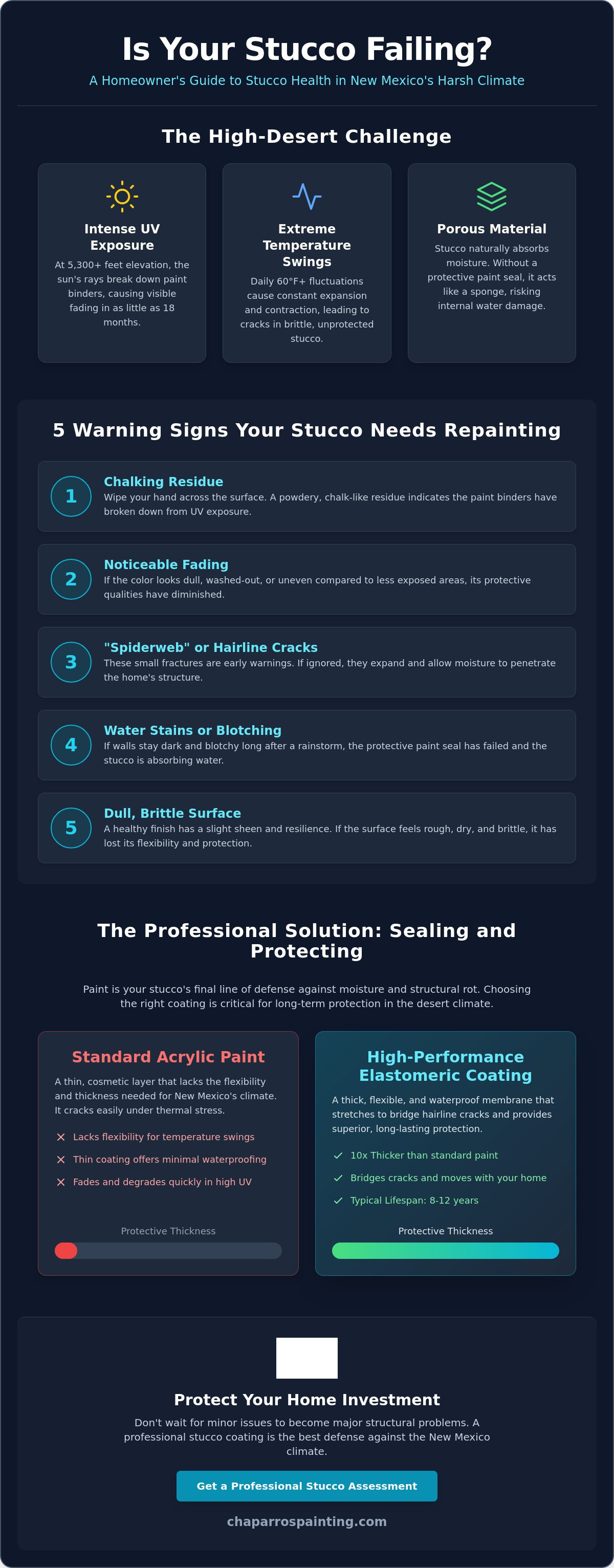
Checking your home’s exterior once or twice a year is a smart habit for any New Mexican property owner. Our environment is uniquely aggressive. Knowing how to tell if stucco needs repainting involves looking past the surface color to see the health of the material beneath. If you spot these five warning signs, your home's protective envelope is likely compromised. Addressing these issues early keeps your maintenance costs manageable and prevents deep moisture penetration.
- Visual Fading: When your home's original vibrant hue turns chalky or pale, the UV protection has reached its limit.
- Hairline Cracks: These "spiderweb" patterns signal that the stucco has become brittle and can no longer flex with temperature changes.
- Chalking: This occurs when the paint binders break down, leaving a powdery residue on the surface of the walls.
- Water Staining: Look for dark, damp streaks near the roofline, windows, or foundation. If these spots remain long after a rainstorm, it means the stucco is absorbing water instead of shedding it.
- Efflorescence: These white, crystalline salt deposits appear when moisture moves through the masonry and evaporates on the surface, leaving salts behind.
The Chalking Test: A 10-Second DIY Inspection
Checking for binder failure is simple. Rub your palm firmly across a dry section of your exterior wall. If a chalky, white residue transfers to your skin, the paint is oxidizing. This isn't just desert dust. Dust can be washed away with a light spray from a hose, but chalking indicates that the paint itself is physically disintegrating. When the binders fail, the coating can no longer repel water or block UV rays effectively. This is a clear indicator that a fresh seal is necessary to prevent the stucco from eroding into a sandy mess.
Reading the Cracks: Cosmetic vs. Structural
Not all cracks are created equal. You can use the "Dime Test" to evaluate the severity. If a crack is wide enough to fit the edge of a dime, it is a significant entry point for water and requires immediate attention. Multiple hairline cracks in a single area are also a red flag. They suggest that the stucco is failing in that specific section. Pay attention to the direction of the fractures. Vertical and diagonal cracks often point to standard home settling. However, horizontal cracks can sometimes indicate more serious structural movement or moisture trapped behind the layers. According to the National Park Service's guide to historic stucco repair, identifying the cause of these cracks is the first step in any successful restoration. Catching these fissures early prevents them from turning into deep structural leaks that invite mold and rot.
The New Mexico Factor: Why Rio Rancho Homes Age Differently
Living in the high desert means your home faces some of the most aggressive weather conditions in the United States. Rio Rancho and Albuquerque homeowners deal with environmental stressors that simply don't exist at lower elevations. If you are wondering how to tell if stucco needs repainting, you have to look at the specific local factors that accelerate wear. The thinner atmosphere at 5,300 feet provides less protection against the sun, while our dramatic temperature shifts physically pull at your home’s exterior every single day.
The wind in our area also plays a significant role. In places like Rio Rancho, wind-blown sand acts as a natural abrasive. It slowly sands down the thickness of your exterior coating, leaving the porous stucco beneath exposed to the elements. During the monsoon season in July and August, this exposure becomes a major liability. Without a solid, thick barrier, the summer rains soak directly into the walls, leading to the dark staining and efflorescence mentioned earlier. If your home hasn't been updated in several years, it may be time for a professional exterior painting evaluation to ensure your moisture barrier is still intact.
UV Degradation in the High Desert
At our elevation, the sun exposure is intense enough to "cook" the elasticity out of standard exterior coatings. This process, known as photo-degradation, breaks down the chemical bonds in the paint. South-facing walls typically show the first signs of sun-scald. You'll notice the original color looks pale and the surface feels rough or "toothy." Using high-reflectivity pigments and 100% acrylic or elastomeric coatings is vital in New Mexico. These products are designed to reflect heat rather than absorb it, which helps maintain the flexibility needed to prevent cracking.
The Freeze-Thaw Cycle in Albuquerque
Winter brings a different kind of threat to Albuquerque exteriors. When moisture gets trapped in hairline cracks during a daytime thaw, it remains there as the temperature drops. Overnight, that water freezes and expands. This expansion is powerful enough to turn a small "spiderweb" crack into a large spall, where chunks of stucco actually fall off the wall. This is why winter is often the most damaging time for a home with failing paint. A fresh, flexible seal prevents this cycle by keeping the water out of the substrate in the first place. Daily temperature swings of 55 to 65 degrees in the spring and fall only make this movement more frequent, stressing the bond of the stucco every twelve hours.
The Chaparro’s Painting Solution: Professional Stucco Care
Once you've identified the signs and understand how to tell if stucco needs repainting, the focus shifts to the restoration process. A professional solution requires more than a bucket of paint and a ladder. At Chaparro's Painting, LLC, we approach every project with the mindset of a seasoned craftsman. We understand that your home is your most significant investment. Our goal is to provide a finish that doesn't just look new but actually functions as a durable shield against the elements. We rely on over 20 years of local experience to guide our choices in materials and techniques.
Preparation is the foundation of our work. We never skip steps because we know that shortcuts lead to premature failure. Our team prioritizes cleanliness and punctuality from the moment we arrive on your property. We treat your home with the respect it deserves, ensuring a tidy workspace and clear communication throughout the project. By the time we finish our prep work, your home’s exterior will be a perfectly primed canvas ready for a long-lasting finish.
Our Multi-Step Stucco Refresh Process
Our methodical approach ensures every square inch of your exterior is ready to accept a new coating. We follow a specific sequence designed for maximum durability in the New Mexico climate. This process is refined to handle the specific stressors of the high desert.
- Step 1: Deep Cleaning. We begin with professional powerwashing. This step removes desert grime, loose debris, and oxidized paint residue that would otherwise prevent the new coating from sticking.
- Step 2: Expert Stucco Repair. We address the cracks and chips identified during your inspection. Our team performs precise stucco repairs, filling fissures to create a seamless moisture barrier.
- Step 3: Premium Coatings. We apply high-build, high-quality exterior coatings. These products are specifically chosen for their ability to bridge small gaps and resist the intense UV radiation found in the Southwest.
Why Local Expertise Matters
Sandoval County presents unique challenges for any exterior finish. The soil composition and frequent high winds in Rio Rancho can be incredibly abrasive. Chaparro's Painting, LLC has spent decades studying how these local conditions impact different paint products. This knowledge allows us to select the best materials for your specific neighborhood. We don't use high-pressure sales tactics. Instead, we offer honest, straightforward advice based on years of successful projects in the Rio Rancho and Albuquerque areas.
Our commitment to doing the job right means we focus on the details that others might overlook. We take quiet pride in our craftsmanship and the peace of mind we provide to our neighbors. Protect your home today with a professional stucco inspection from Chaparro's Painting, LLC. We are ready to help you secure your home’s exterior for years to come.
Protect Your Home Against the High Desert Elements
Your home's exterior is more than just a color choice. It's a critical layer of protection against New Mexico's intense UV rays and dramatic temperature shifts. By keeping an eye out for chalking, hairline cracks, and water stains, you can stop minor wear from turning into a major structural headache. Knowing how to tell if stucco needs repainting gives you the power to act before moisture reaches your home's wooden frame. A proactive approach is always more cost-effective than reactive repairs.
At Chaparro’s Painting, we bring over 20 years of local residential experience to every project in Rio Rancho and Albuquerque. We don't just apply paint; we provide specialized stucco repair and meticulous prep work to ensure a long-lasting seal. Our A+ reputation is built on transparency and pride in our craftsmanship. Don't wait for a small crack to become a costly problem. Get a Free Estimate for Your Stucco Painting or Repair Project today. We look forward to helping you keep your home beautiful and well-protected for years to come.
Frequently Asked Questions
How often should stucco be repainted in New Mexico?
Stucco in New Mexico typically needs repainting every 8 to 12 years. This timeline depends on the quality of the previous coating and the amount of direct sun exposure your home receives. South-facing walls usually show wear faster than other sides. If you're looking for how to tell if stucco needs repainting, check for chalking or fading after the eight-year mark.
Can I just paint over cracks in my stucco?
You should never just paint over cracks without repairing them first. Paint is a thin membrane that will quickly split if the underlying crack isn't filled with a flexible patch. Proper repair involves cleaning the crack and using a masonry-compatible filler. Once the repair is cured, the paint provides the final waterproof seal that protects the internal structure.
What is the best type of paint for stucco exteriors?
High-quality 100% acrylic latex or elastomeric paints are the best choices for the high desert. Elastomeric coatings are particularly effective because they are much thicker than standard paint. They can stretch and contract with the 60-degree temperature swings common in Albuquerque and Rio Rancho. This flexibility prevents the coating from becoming brittle and snapping under environmental pressure.
Is it better to fog coat or paint stucco?
Painting is generally better for existing homes than fog coating. Fog coating is a cement-based finish used primarily on new, unpainted stucco to change the color. It doesn't provide a moisture barrier. A high-quality paint or elastomeric coating seals the porous surface. This seal is essential for preventing water absorption and salt deposits during the summer monsoon season.
How long does a professional stucco painting job take?
A professional project usually takes between 3 and 5 days for a standard residential home. The first day involves powerwashing and initial prep work. We then allow the home to dry completely before beginning stucco repairs. The final days are dedicated to masking windows, priming, and applying the top coats. Weather conditions can occasionally shift this timeline.
Will painting my stucco prevent future cracks?
A fresh coat of paint helps prevent environmental cracks but cannot stop structural settling. By keeping the stucco dry and shielded from UV rays, the material stays more flexible. This prevents the "spiderweb" cracking caused by the intense sun. It's a key part of how to tell if stucco needs repainting; if you see these tiny lines, the protection is failing.
Does stucco painting increase my home value in Rio Rancho?
Can I pressure wash my stucco myself?
It is generally safer to hire a professional for powerwashing. Stucco is a relatively soft material compared to brick or stone. Using a high-pressure setting or the wrong nozzle can easily gouge the surface or force water into the wall cavity. Professionals use specific low-pressure techniques and specialized cleaners to clean the surface without causing structural damage or erosion.


