
Why does a fresh coat of paint in the high desert seem to lose its life after just a few summers? If you've noticed your home looks dull or your stucco is starting to flake, you're certainly not alone. Dealing with common exterior paint problems in New Mexico is a unique challenge because our environment is one of the harshest in the country. Between the intense UV radiation that bleaches color and the dry air that turns paint brittle, your home’s exterior is under constant attack from the elements every single day.
It's frustrating to watch a major investment fade away while new cracks appear in your stucco every spring. You deserve a finish that actually stands up to the heat for ten years or more. This guide identifies exactly why your current paint is failing and explains the difference between a simple cosmetic crack and a structural issue that needs professional stucco repairs. We'll walk through the essential prep work required for our climate and show you how to find a reliable local painter who values craftsmanship over cutting corners.
Key Takeaways
- Understand how extreme UV exposure and low humidity cause "flash-drying," which leads to poor paint adhesion and premature fading.
- Learn to identify common exterior paint problems in New Mexico, including how to distinguish between cosmetic hairline cracks and serious structural stucco failure.
- Discover why thorough prep work, such as powerwashing to remove desert dust, is the single most important factor for a long-lasting finish.
- Gain a checklist of essential questions to ask painting contractors to verify their stucco expertise and ensure they comply with state licensing standards.
- See how a professional 10-step application process provides your home with a durable shield that can withstand the high-desert climate for over 10 years.
Understanding the High-Desert Toll on Your Exterior Paint
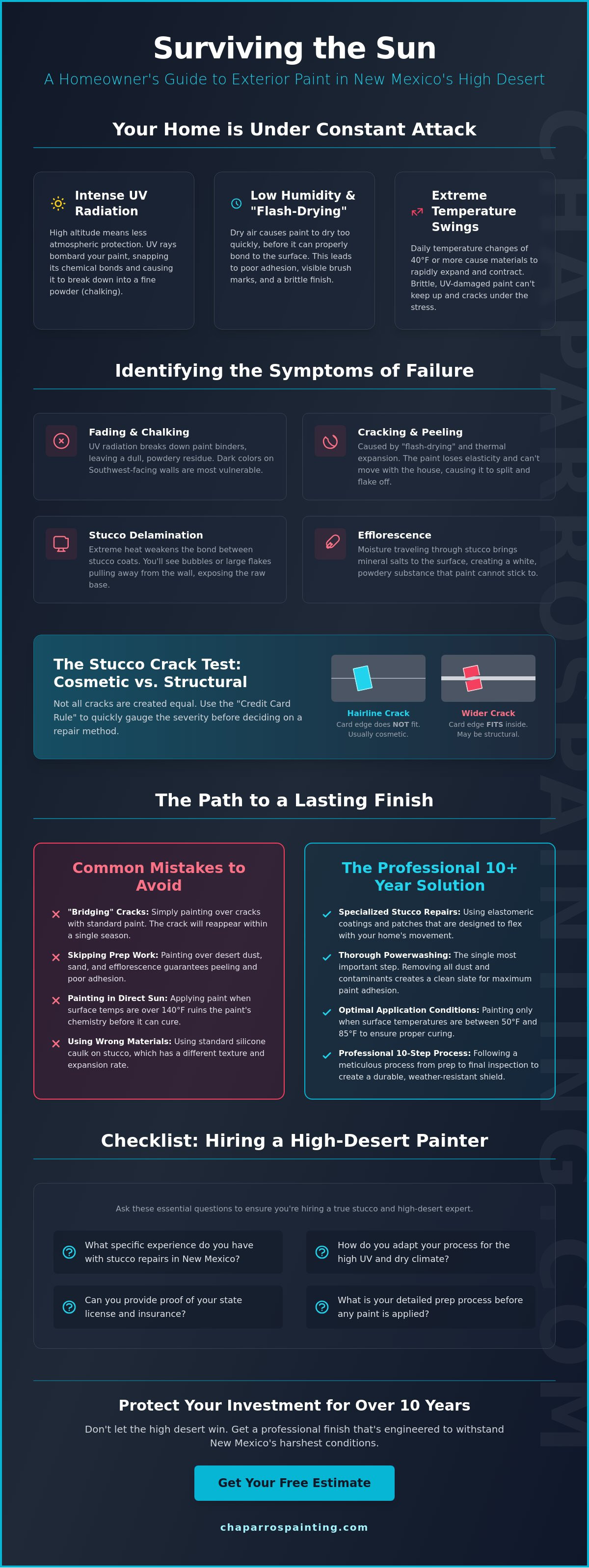
Living in New Mexico means enjoying over 300 days of sunshine every year. While that's great for weekend plans, it's brutal on your home’s exterior. Most common reasons for paint failure in other states involve mold or wood rot. Here, the sun is our primary adversary. The high-altitude atmosphere is thinner, providing less protection against ultraviolet (UV) rays. This constant bombardment causes the chemical bonds in paint to snap, leading to many of the common exterior paint problems in New Mexico that homeowners face every season.
Our low humidity adds another layer of difficulty during the application process. Paint needs time to "level out" and bond with the surface. In our dry air, the water or solvent in the paint evaporates almost instantly. This "flash-drying" prevents the paint from forming a tight, durable seal. It often results in poor adhesion and visible brush marks that never quite smooth over. Without proper technique, the paint just sits on top of the surface rather than gripping it.
We also deal with extreme thermal expansion. It's common to see a 40-degree difference between a chilly morning and a scorching afternoon. This causes your home’s building materials to expand and contract rapidly. If the paint has lost its elasticity due to UV damage, it can't keep up with this movement. The result is cracking and peeling. Even the monsoon season plays a role. Sudden heavy rains can trap moisture behind a failing paint film, leading to blisters when the sun comes back out and turns that water into steam.
The Impact of High-Altitude UV Radiation
At elevations above 5,000 feet, UV intensity increases significantly. This radiation attacks the binders that hold paint pigments together. Once these binders fail, the paint turns into a fine powder, a process known as chalking. Southwest-facing walls bear the brunt of this heat gain. Darker colors absorb even more thermal energy, which can cause the underlying stucco to bake and the paint to bubble or flake away prematurely.
Humidity and Temperature Swings in Rio Rancho
In areas like Rio Rancho, the daily temperature swing puts immense stress on the exterior finish. Painting in the direct July sun is a recipe for failure because the surface temperature can exceed 140 degrees. This heat ruins the paint's chemistry before it even has a chance to cure. The best window for painting is usually when surface temperatures stay between 50 and 85 degrees. We monitor these conditions closely to ensure the product bonds correctly for a finish that lasts.
Stucco-Specific Failures: From Hairline Cracks to Efflorescence
Stucco is the backbone of Southwest architecture, but it requires specific care to survive our environment. One of the most frustrating common exterior paint problems in New Mexico is seeing a stucco finish degrade while the rest of the home looks fine. This often begins with delamination. In our extreme heat, the bond between the finish coat and the base coat can weaken. You might notice areas that look like they are bubbling or pulling away from the wall. If left alone, these sections eventually flake off, leaving the raw base material exposed to wind and sand.
Many homeowners try to hide these issues by simply painting over them. This is called "bridging." Using standard exterior paint to fill cracks is a mistake. Standard paint lacks the elasticity to handle the thermal expansion we experience in the high desert. Instead of a permanent fix, the paint will crack again in the exact same spot within a single season. To get a result that lasts, you often need professional stucco repairs that involve specialized coatings designed to move with your home.
Another silent killer of paint jobs is efflorescence. This is the white, powdery substance you see on the surface of the stucco. It occurs when moisture travels through the material and brings mineral salts to the surface. Paint won't stick to salt. If you paint over efflorescence without treating the underlying moisture issue, the new finish will peel off in sheets. Understanding these material behaviors is essential for any successful renovation project.
Identifying and Repairing Stucco Cracks
Not every crack is a disaster. We use the "Credit Card Rule" to help homeowners gauge severity. If a crack is thin enough that you can't fit the edge of a credit card into it, it's usually a cosmetic hairline crack. These are common and easily managed. If the crack is wider, it might indicate structural settling. Never use standard silicone caulk for these repairs. Caulk has a different texture and expansion rate than cementitious stucco. It will create a visible "scar" on your wall that no amount of paint can hide.
Dealing with Stucco Efflorescence and PH Issues
New stucco is highly alkaline. If you apply paint before the material has properly cured and reached a neutral PH, the alkalinity will "burn" the paint binders. This leads to rapid fading and chalking. For older homes, moisture management is the priority. The NPS guide to stucco preservation highlights how important it is to keep water from getting behind the stucco skin. We use professional cleaning methods to neutralize the surface and ensure it's ready to accept a new, durable finish.
Why Prep Work is the #1 Cause of Failure in New Mexico
Most homeowners blame the paint when they see a finish peel after only three years. In reality, the culprit is almost always what happened before the first can was ever opened. In our high-desert environment, the "invisible" enemy is dust. New Mexico winds carry a fine, silty grit that settles into every pore of your stucco and wood trim. If you apply paint directly over this layer, you aren't bonding to the house; you're bonding to a layer of dirt. This lack of a mechanical bond is one of the most common exterior paint problems in New Mexico, leading to a finish that can be peeled off in large, disappointing sheets.
Preparation in our climate requires more than just a quick sweep. Parched surfaces like old stucco or sun-bleached wood are incredibly thirsty. They will suck the moisture out of the paint before it can properly cure. This is why using professional-grade sealants and high-quality primers is non-negotiable. Without these steps, the paint remains on the surface as a brittle shell rather than an integrated protective layer. The USDA paint failure guide confirms that environmental factors like high heat and intense sun exposure accelerate these failures when the surface hasn't been stabilized correctly.
The Essential Role of Powerwashing
A simple garden hose doesn't have the pressure needed to dislodge calcification or deeply embedded desert silt. We use professional powerwashing to ensure the surface is chemically clean. This step also reveals loose or "hollow" stucco that needs attention before the coating begins. In our arid climate, drying times are faster than in other states, but you still need to wait. We typically allow at least 24 to 48 hours for the moisture to leave the substrate. Applying paint to damp stucco traps water, which will eventually turn to steam in the July sun and cause massive blistering.
Surface Stabilization and Priming
Old stucco often becomes "chalky" over time. We apply a masonry primer to lock down those loose particles and create a uniform surface. This is equally important for wood features like vigas, gates, and trim. If you're planning on wood staining or gate painting, we first scrape away the grey, UV-damaged wood fibers. This exposes fresh wood that can actually absorb the protective oils or pigments. It's the only way to ensure your exterior painting project lasts for a decade instead of just a few seasons.
Questions to Ask a Painting Contractor Before Hiring
Hiring a contractor in the Land of Enchantment requires more than just checking a gallery of photos. You need to understand the local regulatory environment to protect your investment. In New Mexico, contractors with less than $7,200 in annual revenue are not required to be licensed. While this may help small handymen, a full exterior project almost always exceeds this amount. You should always ask to see a valid GB-2 or GB-98 license. Professional painters must also carry a $10,000 contractor license bond and workers' compensation insurance. Verifying these credentials ensures you aren't held liable for accidents on your property.
Price is often the first thing homeowners look at, but the cheapest bid is frequently the most expensive in the long run. A "blow-and-go" contractor saves money by skipping the labor-intensive cleaning and priming steps. This directly leads to common exterior paint problems in New Mexico, such as rapid peeling and chalking. When reviewing a proposal, look for line items that specify powerwashing, scraping, and the use of high-quality masonry primers. If these aren't listed, the contractor is likely planning to paint over the desert dust, which guarantees a short-lived finish.
The Essential Interview Checklist
Ask specific questions to gauge a contractor’s understanding of our climate. First, ask about their stucco crack repair process. They should be using cementitious materials or high-performance sealants, not standard painters' caulk. Ask how they manage the monsoon season. A professional will use a moisture meter to ensure the substrate is dry before applying a new coat. Finally, ask about their cleanup process. Desert landscaping with gravel and cacti is difficult to clean once paint chips fall into it. A reliable team will have a clear plan for protecting your yard and disposing of waste properly.
Reviewing the Proposal and Warranty
A professional proposal must be transparent and detailed. It should name the specific brand and product line of the paint. High-quality paints with superior UV resistance are essential for our 5,000-foot elevation. Ensure the document includes a written warranty that specifically covers peeling and blistering. In New Mexico, a standard paint job should last at least 7 to 10 years if the prep work is done correctly. If you want a team that values this level of thoroughness, schedule an exterior painting estimate with a contractor who understands the local standards for durability.
Professional Protection with Chaparro’s Painting
At Chaparro’s Painting, LLC, we have spent over 20 years refining our approach to the high-desert climate. We understand that a house in Rio Rancho faces different challenges than one in the Midwest. Our team approaches every project with the mindset of a seasoned craftsman. We don't believe in shortcuts. We know that skipping even a minor step in the preparation phase leads directly to the common exterior paint problems in New Mexico that we've discussed. Our goal is to provide a finish that stays vibrant and intact for a decade, not just a few seasons.
Our meticulous 10-step prep process is the foundation of our work. This includes professional powerwashing to remove silt, detailed scraping of wood gates, and expert stucco repairs for those hairline cracks. We also specialize in gate painting and wood staining, ensuring every part of your home’s exterior is shielded. We take quiet pride in our craftsmanship. This means maintaining a clean job site and providing transparent, honest communication from start to finish. You won't have to worry about contractors who don't show up or leave a mess behind.
Our Local Expertise in Rio Rancho and Albuquerque
We focus exclusively on residential painting in the Rio Rancho and Albuquerque areas. This local focus allows us to select paints with the highest UV resistance available. We understand how solar heat gain affects southwest-facing walls, so we choose products with superior binders. Our team values your time. We show up when we say we will and provide clear updates throughout the service process. It’s about more than just paint; it’s about the peace of mind that comes from dependable, high-quality service.
Get Your Free Exterior Evaluation
A Chaparro’s Painting, LLC estimate is more than just a price tag. It is a thorough evaluation of your home’s current condition. We look for hidden issues like efflorescence or failing sealants before they become costly structural repairs. We identify exactly what your specific home needs to survive the next ten years of sun and wind. You can expect a straightforward, no-pressure conversation about the best way to protect your property. Protect your home today with a free estimate and see the difference that professional standards make.
Protect Your Home Against the High Desert Elements
Your home is likely your biggest investment. In our climate, maintaining its exterior is a constant battle against the sun and wind. You now know that the most common exterior paint problems in New Mexico stem from poor preparation and a lack of understanding of stucco behavior. Success requires moving beyond simple cosmetic fixes. You must address the root causes of failure, such as desert silt and UV degradation, to achieve a finish that stands the test of time. A professional approach ensures your stucco remains sealed and your color stays vibrant for years to come.
Choosing the right partner makes all the difference in achieving these results. Chaparro’s Painting is owner-operated for strict quality control. We bring more than 20 years of local experience to every project. As specialized stucco repair experts, we ensure your walls are properly stabilized before the first drop of paint is applied. We invite you to schedule your free professional painting estimate with Jaime Chaparro. We look forward to helping you protect and beautify your home with a finish you can be proud of.
Frequently Asked Questions
How long does exterior paint typically last in New Mexico?
Exterior paint in our high-desert climate typically lasts between 7 and 10 years when applied correctly. This lifespan depends heavily on the quality of the product and the thoroughness of the initial preparation. High-altitude UV exposure will eventually break down even the best binders. Regular inspections every few years can help you catch minor fading before it turns into a major peeling failure.
Can you paint over stucco that has hairline cracks?
You should never paint directly over hairline cracks without first stabilizing the surface. While these small gaps are often cosmetic, they allow moisture to seep behind the stucco skin. We use specialized sealants or cementitious patches to fill these voids before the first coat. This prevents the "bridging" effect where paint stretches and snaps over an unrepaired crack during temperature swings.
What is the best time of year to paint a house in Albuquerque?
The ideal months for painting in Albuquerque are typically late March through May and September through early November. During these windows, daytime temperatures usually stay within the optimal 50 to 85-degree range. Avoiding the extreme heat of July and the unpredictable moisture of the monsoon season ensures the paint cures slowly and bonds properly to the substrate.
Why is my paint bubbling or blistering on the sunny side of my house?
Bubbling on sunny walls is often caused by localized heat gain or trapped moisture. Dark colors on south-facing walls absorb significant thermal energy, which can cause the paint film to expand and pull away from the stucco. This is one of the most visible common exterior paint problems in New Mexico. It often indicates that the previous layer wasn't fully bonded or that moisture is escaping from the wall.
Is elastomeric paint better than regular acrylic for New Mexico homes?
Elastomeric paint is excellent for stucco with frequent movement, but it isn't always the better choice for every home. It is thicker and more flexible than standard acrylic, making it great for waterproofing and bridging small cracks. However, it must be applied at the correct thickness to be effective. For many homes, a high-quality 100% acrylic latex provides plenty of durability without the higher material costs.
How much does prep work affect the final cost of a painting project?
Prep work usually accounts for the majority of the labor cost in a professional project. This includes powerwashing, scraping, masking, and making stucco repairs. While it adds to the initial estimate, it is the only way to guarantee a result that lasts a decade. Cutting corners on prep is the primary reason why cheap paint jobs fail within just a few years.
Should I powerwash my house myself before the painters arrive?
We recommend letting your professional painting team handle the powerwashing. Professional equipment provides the right pressure to remove desert silt without gouging the stucco or forcing water into window seals. Additionally, painters need to coordinate the wash with their schedule to ensure the surface has the necessary 24 to 48 hours of drying time before application begins.
What are the most durable exterior paint colors for high-sun areas?
Lighter earth tones like tan, beige, and soft greys are the most durable choices for the New Mexico sun. These pigments reflect more UV radiation and show less fading over time than deep blues, reds, or dark browns. Choosing a color that mimics the natural landscape helps hide the inevitable accumulation of desert dust while keeping your home's surface temperature much lower.


